
Ode to Mary
Happy Birthday Mary Shelley


On New Year’s Day, 2024, I picked up a monster of a book. It was a 547 page dual-biography called Romantic Outlaws: The Extraordinary Lives of Mary Wollstonecraft and Her Daughter Mary Shelley by Charlotte Gordon. I spent the month of January chipping away at it, admittedly expecting this tome to be a bit of a chore to read. Except, to my surprise, this book was a total page turner. I was compelled to lug this massive book around New York with me, heaving it onto my work desk to flip through a couple more pages between emails, balancing unsuccessfully on the subway because I needed both hands to hold it, not caring if judgmental eyes called me “performative” behind my back. I think I finished reading it in the children’s section of my climbing gym while waiting for my friends to arrive for a bouldering session. Mary Wollstonecraft and Mary Shelley led page-turner lives, and on the anniversary of Mary Shelley’s birth (from which Mary Wollstonecraft later died of complications), it feels appropriate to take a second to celebrate them.
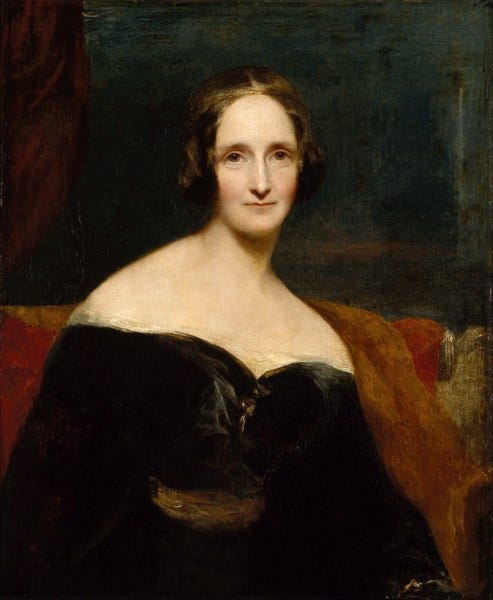
I admit, until I picked up this book, I had no idea that the original feminist was the mother of the mother of science fiction. And while I knew of Mary Shelley from my high school English unit on Frankenstein, I had never heard of Mary Wollstonecraft before. Here are my impressions of both of them, based on this biography:
Mary Wollstonecraft epitomizes the phrase “Nevertheless, she persisted.” In my life, I hope to emulate her dedication, discipline, and drive. She acquainted herself with many of the great thinkers of the time; she was in Paris during the French Revolution and lost many friends and colleagues to the guillotine; and of course, she authored one of the earliest feminist works: A Vindication of the Rights of Women. She supported herself and her siblings with her writing, having no family money to rely on. She was independent, and somehow, she was doing this back in the late 1700s.
I don’t know if I would like to be her friend, to be honest. The biography includes excerpts from the letters she wrote to a childhood friend, demanding loyalty and attention and running hot and cold when she didn’t get the kind of response she wanted. I read these snippets and thought “Oh god, Mary, no…” But I understood her feelings. I remember feeling insecure in friendships around middle school. I too sent many desperate emails to friends, or later, cringe-worthy double-texts to guys that just weren’t that into me. Here’s the thing though. When Mary Wollstonecraft bombarded the father of her first daughter with letters, trying to respark his interest in her (and no, I am not trying to equate “he won’t text me back” with “the father of my child is absent”), these letters became the basis of Letters Written During a Short Residence in Sweden, Norway, and Denmark. This book was popular upon publication, and set the stage, as Charlotte Gordon argues, for the romantic movement. Mary Wollstonecraft managed to take her work written at a moment of vulnerability and transform it into something resonant and reflective. You absolutely will not be seeing me do that with my unfortunate emails.
Mary Wollstonecraft spent much of her life surrounded by thinkers, but largely detached from any one place or person; she was a trailblazer. Her daughter, Mary Shelley, spent much of her adult life accompanied by her lover and later husband Percy Shelley and was ostracized from society because Percy was ALREADY MARRIED when they first ran off together (salacious, I know. I told you this was a page turner). Because of this arrangement, Mary Shelley was at the mercy of Percy’s questionable decision making and ended up taking somewhat of a backseat in how her life was driven. She had to manage the logistics and practicalities of their literary life; they were unwelcome in polite society (it’s telling that Lord Byron was the one to take them in that one famous summer) and were relying on a poet’s meager earnings. But she was a writer in her own right; she kept journals, and she and Percy supported each other’s work by editing and discussing their ideas together. When she was 18, while she and Shelley stayed in Geneva with Lord Byron for a summer, this literary circle of guests challenged one another to each write a ghost story. Drawing inspiration from the tumults of her own childhood and the scientific fascinations of the time, she produced Frankenstein, one of my favorite stories of all time.
While Mary Wollstonecraft inspires my creative spirit, Mary Shelley is the one I wish I was friends with: one, because I think we would get along, two, because I think she needed a friend through everything, and three, because I wish I could have edited Frankenstein for her—I would argue it needs one more pass through for polish. While she is known for Frankenstein, she has several other published works that sit in my TBR pile, because the mind that comes up with something like Frankenstein is a mind I want to continue engaging with.
I just want to highlight the fact that one of my big reactions to reading this biography was noticing how useless, unremarkable, or just plain awful all of the men in both Marys’ lives were (with the exception of Mary Wollstonecraft’s publisher, Joseph Johnson, who facilitated her becoming a writer and was basically just the best). Mary Wollstonecraft had two affairs that ended badly, one resulting in her becoming a single parent. She later married William Godwin (Mary Shelley’s father) who was famous for his Enquiry Concerning Political Justice, but then Godwin wrote a posthumous biography about her that exposed her personal affairs, destroyed her reputation, and sent her into obscurity for decades. Percy continually had affairs with other women (including, allegedly, Mary Shelley’s step sister) even during periods where Mary was grieving the loss of one of their children (only one child survived to adulthood). He became obsessed with building a boat and sailing it, despite the fact that he could not swim, and then, lo and behold, he died in a boating accident, leaving Mary and their living son penniless. Mary’s father relied on her and Percy financially but refused to take them in when they found themselves social pariahs. When Mary sent her father the manuscript of her novel Mathilda to coordinate publishing, he not only refused to see it published, he wouldn’t send the manuscript back to her, and need I remind you, they did not have copies back then (Yes, I'm looking at you, Amy March! Unforgivable...). Sometimes while reading the biography, it seemed like every bad thing that happened to both Marys stemmed from some stupid or harmful choice a man made. All of the stuff they accomplished, they accomplished despite the men around them.
And they accomplished so much! They were writers, mothers, outcasts, thinkers, wives, readers, breadwinners. They did it all, and they did it all by hand (seriously, how did they not get carpal tunnel from writing and keeping up with their correspondence all the time). They inspired future generations, and they demonstrated the possibilities of life and thought for women beyond the boundaries of nineteenth century society.
So, I challenge you to pick up Romantic Outlaws, and don’t let the size of the book daunt you. May Mary Wollstonecraft light a fire under you to pursue your goals, and may Mary Shelley ground you to do it right.
Happy birthday Mary S., and rest in peace Mary W.
Love, Max
 | A guest post by
|